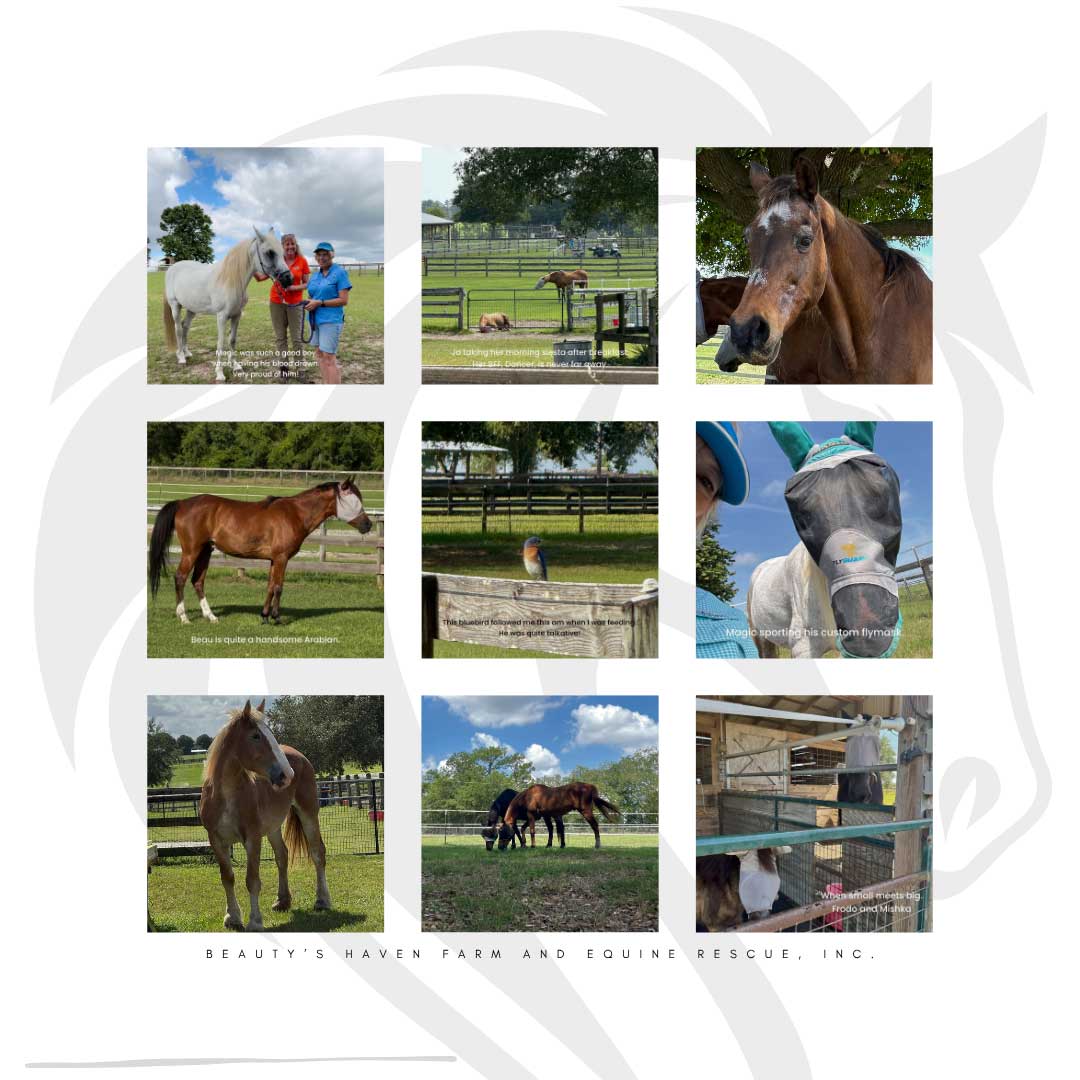
Photo collage of senior horses that were evaluated by Dr. Dianne McFarlane.

Dr. Dianne McFarlane came out recently to do tests for Cushing’s Disease on some of our horses. She is Chair of the Department of Large Animal Clinical Studies at University of Florida’s College of Veterinary Medicine. Her special area of interest is aging and age related diseases of the senior horse, and we just happen to have quite a few of those here at Beauty’s Haven! Cushing’s Disease is a pretty common neurodegenerative disease that usually affects older horses. Dr. McFarlane hopes to better understand the disease by identifying genetic mutations in order that treatment for Cushing’s can be started earlier.

Valley Girl, the only horse here so far to test positive for Pigeon Fever, is one of the horses Dr. McFarlane tested for Cushing’s and she is positive. This could be a contributing factor to why it is taking her so long to recover from Pigeon Fever. She is better but she’s still working through it. There have been quite a few cases over the past couple of months in and around the Ocala area and there will likely be more as flies are the carriers and they’ve been truly horrible this year. Plus, it’s been very dry.

The first photo is of Dr. McFarlane with Magic. He was so good getting his blood drawn – I was very proud of him! His Cushing’s test was negative but a few others did test positive so they are getting a medication called Prascend. And I thought I’d just share a few other photos while I have a chance.

On Wednesday, I saw two dogs posted on Facebook who were seemingly abandoned in the middle of a forest of an agricultural area, located close to the rescue. As I simply could not ignore these poor pups, I decided to go search for them which was like looking for a needle in a haystack. After searching for a few minutes, I stopped on the side of the road and said a prayer, and then, lo and behold, I saw ears! The dogs were a male and a female who had possibly been used for breeding purposes and I feared that they may have been dumped as neither dog was wearing a collar or tags. They were quite timid, but they did eat a few treats and were quite thankful for water. Both, however, did not wish to be touched.

I called Diane to ask if she could help as I didn’t have a cage with me at the time. After Diane arrived with her cage, we had absolutely no luck as neither dog would even go near it. As the heat was unbearable, coupled with my terrible reaction to numerous bug bites causing my tongue to swell, I knew I had to immediately get home as I did not have my Epi-pen with me. We had no other choice but to leave these sweet pups and return in the morning in hopes they would get used to the cage overnight. Prior to leaving, they were both fed and given water which would hopefully last until morning when I planned to return with a larger, remote-controlled cage. Needless to say, I did worry about them throughout the night and hoped and prayed that they did not encounter any predators, like gators, coyotes or other wildlife.

Happily, when I arrived Thursday morning, I was truly blessed to discover the good Lord had indeed watched over them; upon my arrival, both approached me, with tails wagging!

I didn’t want to let another week end without sending out an update. To say we’ve been extremely busy would be an understatement. As some of you know, Valley Girl got sick about a month ago. It started with edema under her tummy. She was examined by the vet and blood tests were done. Over the next couple of days without improvement, the vet came back and did an ultrasound. A culture was also done and, unfortunately, the results were positive for dreaded Pigeon Fever. Valley Girl had already been separated from other horses and the barn was placed in lockdown. Valley has had a few abscesses rupture from her tummy to her chest. She had another, hopefully the last, to open yesterday.

Each horse is inspected from head to toe daily, sores are treated, SWAT and fly spray are applied, and fly masks are changed.

A couple of weeks ago, we found swelling on Addi’s chest that was suspect, so we put her in quarantine. The vet examined her and performed blood tests and a culture. Most recently, Mo also had some chest swelling so the vet came again to examine him, do a culture and run blood tests. Cultures for both Addi and Mo came back negative, but, out of an abundance of caution, we continue to treat them as a worst case scenario. Since then, the vet has lanced the swelling on Addi’s chest in order to drain and collect the discharge, but there is still some swelling. Mo had one open under his tummy on Friday and although I collected the discharge, he continues to experience some swelling.

Pigeon Fever is transmitted mostly by flies carrying the bacteria when they land on a horse that has open sores or wounds. It is, thankfully, not transmitted nose to nose like strangles. We don’t know where it originated but we are located in an agricultural community and have farms all around us with cows, horses, goats, etc. and the flies are absolutely horrible this year. It is possible that it was already in the ground, but we’ve been here almost twenty years and never before have had this issue.

Bio-security is real and it takes time and resources, all day, every day. Volunteers have been very good about following protocols put in place. It’s been quite an expensive, and exhausting, endeavor with no end yet in sight.

We’ve invested quite a bit into bleach, exam gloves, fly spray, SWAT, etc. If anyone would like to help, we would greatly appreciate it. Donations are tax deductible and no amount is ever too small. We don’t know how much the veterinary bill will be, but we will share it once it is received.

A few of our needs can be found on our Amazon Wish List: https://www.amazon.com/hz/wishlist/ls/363QQBR2KM14O

Thank you and have a safe and blessed weekend.

Flint, a very special and sweet Quarter Horse gelding with a heart of gold, went to Rainbow Bridge early Friday morning. He came to us back in December, literally skin on bones. He was a wise, grateful, and loving soul who always seemed to be smiling – and such a beautiful smile he had. His rehabilitation went well and he became wonderful friends with Kalista and Amira. He had been living a good and happy life.

Temperatures warmed up recently and when that happens, I think we all tend to slow down a little – both humans and horses alike. We’ve been dealing with some other issues which I will share at a later time, but we have been diligently checking each and every horse every morning for any signs of illness.

At the morning meal on Thursday, Pam contacted me on the radio to inform me that Flint didn’t finish his breakfast and had walked away and laid down. This was not a good sign.

He was in a paddock at the south end of the property where he stayed with Kalista and Amira. I immediately went to assess him and he was up when I arrived. His respiration was slightly elevated, his gums looked good, and his temperature was normal, but he clearly wasn’t himself. I walked him up to the barn after giving him some Banamine and on the way, he wanted to graze, so we stopped for a bit and he passed poop which was a good thing. Afterward, he was tucked into a nice clean stall with fresh water so we could monitor him. He perked up, ate all of his mushy lunch, passed more manure, ate hay, and drank water. Since his eyes were bright, we let him out of the stall. He grazed for a bit and passed more manure.

By late evening, he wasn’t himself once again. Jessica was here and took his temperature and checked his vitals. His temperature was normal, his gums were pink and moist, but his HR and RR were slightly elevated. With this info, I called the vet and we followed instructions regarding what medications to administer and we were instructed to withhold hay and grain and to keep him stalled for the night. He passed more poop and drank more water before lights went out at about midnight.

When I checked on him at 6:15 yesterday morning, he had passed more poop and drank more water. He looked tired and worried, but not painful. I was going to call the hospital at 7:30 am but shortly after 7:00 am, he collapsed. There was no struggling at all – he was just gone. My heart shattered. We don’t know if it was a possible GI issue such as a rupture from a strangulating lipoma, his heart – or perhaps internal bleeding from a ruptured aorta, or some other issue. He was twenty-seven years old.

Flint now runs with our heavenly herd at Rainbow Bridge with Beauty in the lead. While our hearts are torn, we are grateful for the few months that we had with him.

Flint knew love, received daily attention from multiple humans, was served nutritious meals multiple times a day, and he had many horse friends. He will forever remain in each of our hearts.